Materials and construction
Humidity Resistant Kitchen Cabinets: What to Specify
Key points
- Moisture enters through edges, joints and cut-outs far more than through faces.
- Specify a plywood carcass with every edge banded, including hidden ones.
- Seal sink, hob and pipe cut-outs and fit a protective base liner in sink units.
- Choose stable, non-porous fronts such as acrylic, melamine or thermofoil.
- Protect the cabinets beside the dishwasher and under the sink from steam and leaks.
Ask a UAE maintenance team which kitchen cabinet fails first and the answer is almost always the same: the sink base. A slow leak from a trap, steam from a dishwasher or condensation on a cold-water pipe works into an unsealed edge, the board swells and the door stops closing. Humidity resistant kitchen cabinets are not a single product. They are a set of details, and every one of them matters.
Our guide to choosing kitchen cabinets for the UAE climate covers heat, sun and air-conditioning. This article goes into the moisture details: what to specify, where, and why.
Where moisture gets in
A melamine, acrylic or lacquered face is close to waterproof. The weak points are elsewhere:
- Raw edges: any board edge without banding, including the hidden back edges of shelves and cabinet bases.
- Cut-outs: holes for sinks, taps, hobs, pipes and cables, cut on site and left bare.
- Joints: where the cabinet base meets the sides, and where worktops meet walls and upstands.
- Hardware holes: hinge cups, shelf-pin holes and screw holes that pass through the surface layer.
- The floor: plinths and legs standing in water after floor cleaning.
Once water reaches the core of a chipboard or MDF panel, the swelling is usually permanent. Good specification is about closing every one of these routes.
Start with the board
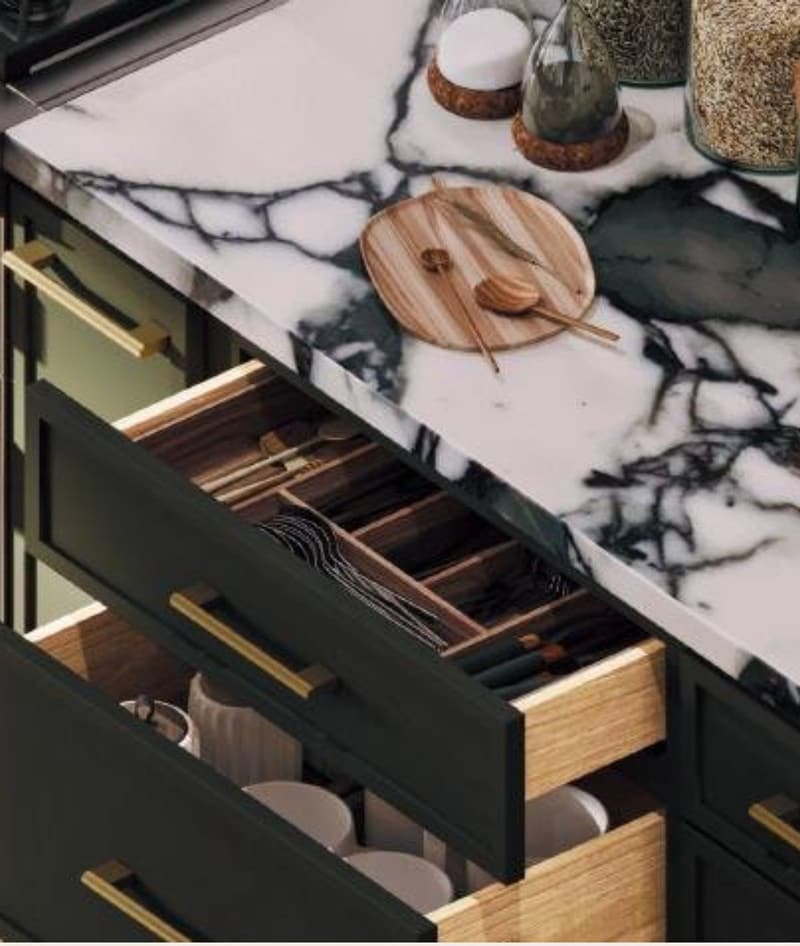
The carcass is the part of the kitchen most exposed to leaks and least visible to buyers, so it is where cheap boards are most often used. Plywood, built from cross-laminated veneers, holds its shape and its screws far better than chipboard when it gets wet. All five of our cabinet constructions use plywood carcasses; our Frameless construction, used behind Prism and all nine signature door ranges, finishes the 18 mm plywood in white melamine, inside and out. The full comparison is in plywood vs MFC.
Shelves deserve the same attention. A shelf in a sink base or next to the dishwasher should be plywood or fully edged, not a bare-edged chipboard panel.
Edge banding: every edge, not just the visible ones
Edge banding is the strip applied to a board's cut edge. On a quality cabinet, every edge is banded, including the back edges of shelves, bases and sides that no one sees. Check three things:
- Coverage: all four edges of every panel in wet zones.
- Adhesive: a tight, continuous glue line with no gaps at the corners, where water creeps in first.
- Thickness: thicker banding on door and drawer-front edges takes knocks without chipping, which keeps the seal intact.
Fronts that stay stable
Doors and drawer fronts face steam from kettles, cooking and dishwashers. Non-porous, factory-finished fronts suit humid kitchens best:
| Front | Humidity performance | Example |
|---|---|---|
| Acrylic-faced board | Sealed, glossy face; edges must be well banded | Lustre |
| Melamine (smooth or textured) | Tough, wipe-clean, stable | Dusk, Ember |
| Vinyl-wrapped MDF (thermofoil) | One continuous skin over face and edges; keep away from direct oven heat | Spectrum |
| Painted solid-wood frame | Frame and panel construction allows movement; needs a durable factory finish | Meridian |
The sink base
Give the sink unit its own specification line:
- A plywood carcass with all edges banded and the base sealed.
- A removable, waterproof base liner or tray that catches drips before they reach the board.
- Silicone sealant around the sink cut-out and tap holes, applied on site before the sink is fitted.
- Pipe holes in the back panel cut neatly and sealed, with a gap so pipes do not rub through the edge.
- No shelf across the full depth, so leaks are seen early instead of hidden.
Beside the dishwasher
When a dishwasher opens mid-cycle, a cloud of steam rolls up the face of the worktop and the cabinet beside it. Specify a moisture barrier strip or steam shield under the worktop above the dishwasher, band the edges of the adjacent cabinet sides fully, and use end panels where a dishwasher sits at the end of a run. Tell residents to wait for the cycle to finish before opening.
Hardware and plinths
- Hinges and runners: choose plated or coated hardware that resists corrosion in coastal air. Soft-close dampers should be sealed units.
- Legs and plinths: adjustable plastic legs keep the carcass base off a wet floor. A plinth with a seal strip at the bottom stops cleaning water running underneath.
Installation details
Even the best cabinet can be let down on site. Ask your fit-out contractor to seal every cut-out made on site, run a continuous silicone bead where worktops meet walls and upstands, leave a ventilation gap behind tall appliance housings, and test all plumbing for leaks before the kickboards go on. Our design service includes these details on the shop drawings, so the site team has them in writing.
A checklist for wet zones
- Plywood carcass, every edge banded, including hidden edges.
- Non-porous factory-finished fronts.
- Base liner and sealed cut-outs in every sink unit.
- Steam protection above and beside the dishwasher.
- Corrosion-resistant hardware and legs that lift the carcass off the floor.
- Sealing and leak testing written into the installation method.
Sanyang has manufactured kitchens for more than 25 years and ships 500+ containers a month to the US, with a 10-year warranty on our cabinets. Visit our Deira showroom to see the carcasses and finishes in person, or contact our team with your project.
Frequently asked questions
What makes kitchen cabinets humidity resistant?
A plywood carcass, edge banding on every edge including hidden ones, non-porous factory-finished fronts, sealed cut-outs and hardware that resists corrosion. Most moisture damage starts at an unsealed edge or cut-out.
Which part of the kitchen is most at risk from moisture?
The sink base, followed by the cabinets and worktop next to the dishwasher. Give both their own specification for sealing and protection.
Are acrylic and melamine doors suitable for humid kitchens?
Yes. Both have sealed, non-porous faces that resist steam and wiping. The edges must be properly banded to keep moisture out.
How do you protect a cabinet next to a dishwasher?
Fit a steam shield or moisture barrier under the worktop above the dishwasher, band the neighbouring cabinet edges fully and use an end panel where the dishwasher ends a run.
About the author. Written by Sanyang's design and technical team, drawing on more than 25 years of manufacturing kitchen and bathroom cabinetry and more than 500 containers a month shipped to the United States. About Sanyang.